By Eric Vandenbroeck and co-workers
The Context Of Lashkar-E-Taiba
The explosions on the
India-to-Pakistan passenger
train late Feb. 18, 2004
were caused by timed incendiary devices (TIDs), rather than by much more
commonly used improvised explosive devices (IEDs). Although this appears to be
the first TID attack against India's rail system, the technology in these
timers is not new. German army plotters, for example, used a similar device in
an attempt to assassinate Adolf Hitler in July 1944. Furthermore, similar
attacks using TIDs were attempted on trains traveling in western Germany in
August 2006, though the devices failed to ignite. Four people were taken into
custody in Lebanon and Germany in connection with the potentially devastating
plot. Although the attack in Germany failed, this latest firebombing sets a
potentially dangerous precedent, especially since TIDs can be more easily constructed
-- and with more readily available materials -- than more complex
high-explosive IEDs.
Lashkar-e- Taiba was
the first organization to carry out suicide attacks in Kashmir. It claimed to
have carried out more than fifty suicide missions against security forces,
while the Jaish-i-Mohammed, which followed its
example, was supposedly responsible for thirty such missions since 2001.( Azmat
Abbas, "The Making of a Militant;' Herald (Karachi), July 2003, p. 58).
Although it has
changed its name, Lashkar-e- Taiba has remained a prominent jihadi organization
of Ahl-e-Hadith persuasion. There are differences among and within Islam's two
schools of thought on the meaning, purpose, and means of carrying out jihad. Many
organizations of the Ahl-e-Hadith sect support only "greater jihad:' which
calls for self-purification. They consider militant jihad a "lesser"
struggle, which, in the case of Kashmir , can only be justified if "the
oppression of the Kashmiri people will be alleviated and an Islamic state will
be established there .... However, when it is evident to any sensible person
that our struggle will not yield the above results, why should we waste
our resources and energy there?" (Abu Fattada,
"Open the Lock with the Key;' Siratul Mustaqeem,
June 1995, p. 22).
At the other end of
the spectrum is Jamaat-al-Dawa and its military wing, Lashkar-e- Taiba, which
considers militant jihad "absolutely obligatory:' It vows to do jihad
until certain objectives are achieved:
Muslims should fight as long as a dispute persists; it is obligatory for
Muslims to fight till Allah's kingdom is established in the world; and till
they finish all governments by infidels and extract jeziya
[tax] from them; if oppression is going on in any part of the world, Muslims
should fight it till it is removed; if any infidel kills a Muslim, we should
fight to avenge it; if any nation perpetrates a breach of contract against
Muslims, it is obligatory to fight with that nation; when any nation takes an
aggressive posture on Muslims, we should fight in self-defense; if the infidels
encroach upon any part of a Muslim land, it is obligatory to fight them and
restore it. The last point identifies such lands that must be reclaimed. It
includes Andalusia ( Spain ), Palestine and the whole of India (including
Kashmir, Hyderabad , Assam , Bihar, Junagarh), and Nepal and Burma . It also
mentions other countries such as Bulgaria , Hungary , Sicily , Russian
Turkistan, and Chinese Turkistan. Abdul Salam bin Mohammad, Why We Do Jihad?
(Department of Communication and Publications of AI-Dawa, May 1999).
Nonetheless, dominant
jihadi organizations of both schools of thought practice militant jihad and
share a pan-Islamic agenda, which has shaped their political discourse. The
proponents of a transnational Islamic identity define the millat
as the world's entire Muslim population. Their self-professed goal is to
establish a grand Islamic state stretching across the Middle East, Kashmir,
Pakistan, Afghanistan, Iran, and Central Asia, similar to the Islamic Caliphate
of medieval times. (Riyaz Punjabi, "The Concept of Islamic Caliphate: The
Religious and Ethnic Pulls of Kashmir Militant Movement;' United Kashmir
Journal, May-June 1994, p. 2).
The Harkat-ul-Jihad Islami manifesto, for instance, states that
"the prime purpose of this Jamaat is dominance of Islam all over the world
. . . . [W] e will never rest content until we attain a threefold objective:
freedom of all occupied Muslim areas, complete protection of all Muslim
minorities and the regaining ofIslamic glory:' It
offers to serve as "a second line of defence of
each Muslim country."A political pamphlet of
Harkat-ul-Ansar (n.d.). See also Kamran Khan, "Harkatul-Ansar: Pakistan 's Islamist Commandos Engaged in
jihad Worldwide," News ( Lahore ), February 13, 1995. According to Abu
Jindal, a Harkat-ul-Ansar member apprehended by the
army at Charar-i-Sharif,
"Jihad means to kill all those who are not Muslims. Only Muslims who
practice the religion truly should live, [and the] rest [of] all the people
should be put to death." An army officer's conversation with Abu Jindal as
told to the author. See also his interview in Kashmir Times, May 17, 1995.
Muhammad Amir Rana’s
,in A to Z Of Jehadi Organizations In Pakistan ( 2004) details:
Organizational
network of Lashkar-e- Taiba: Punjab 30; Sindh 7; Azad Kashmir 2; and Jhelum, Kabirwala, Kehrorpacca, Tonsa, Moro, Shehdadpur, Dadoo, Jafarabad, Badain, Jaam Nawaiz
Ali, Obaaro (Ghotaki), Rawalkot, Bhamber, Kotli, Wailamgarh, and Muzaffarabad. Total 55. Training camps:
After the closure of camps in Afghanistan and Manshera,
only five LT camps were working: Tayyaba, Aqsa, Ummul Qura, Abdullah bin
Masood, and Markaz Muhammad bin Qasim. It also has ten madaris.
Sources of funding:
Funds are collected within Pakistan and abroad. About Rs 20 crores were
collected in 2001 as follows: External Affairs, 2 crore; profit of Dar-al Andalus, 80 lakhs; Students' Department, 35 lakhs; hides of
sacrificed animals, 2.5 crore; Department of Women, 70 lakhs; Department of
Peasant and Labor Wing, 45 lakhs; miscellaneous, 6 crore. It also gets
contributions from Arab states. Saudi Arabia , in particular, and its units in
European countries send substantial contributions to the jihad fund every year.
Sources of
recruitment: It has a wide network of recruitment in Pakistan , which is
concentrated in Sindh and southern Punjab . Among LT's 1,106 mujahideen killed
in Kashmir , 365 were from Sindh. Organizational networkof
Lashkar-e- Taiba: Punjab 30; Sindh 7; Azad Kashmir 2; and Jhelum, Kabirwala, Kehrorpacca, Tonsa, Moro, Shehdadpur, Dadoo, Jafarabad, Badain, Jaam Nawaiz
Ali, Obaaro (Ghotaki), Rawalkot, Bhamber, Kotli, Wailamgarh, and Muzaffarabad. Total 55. Training camps:
After the closure of camps in Afghanistan and Manshera,
only five LT camps were working: Tayyaba, Aqsa, Ummul Qura, Abdullah bin
Masood, and Markaz Muhammad bin Qasim. It also has ten madaris.
Sources of funding: Funds are collected within Pakistan and abroad. About Rs 20
crores were collected in 2001 as follows: External Affairs, 2 crore; profit of
Dar-al Andalus, 80 lakhs; Students' Department, 35
lakhs; hides of sacrificed animals, 2.5 crore; Department of Women, 70 lakhs;
Department of Peasant and Labor Wing, 45 lakhs; miscellaneous, 6 crore. It also
gets contributions from Arab states. Saudi Arabia , in particular, and its
units in European countries send substantial contributions to the jihad fund
every year. Sources of recruitment: It has a wide network of recruitment in
Pakistan , which is concentrated in Sindh and southern Punjab. Among LT's 1,106
mujahideen killed in Kashmir, 365 were from Sindh.
The Lashkar-e- Taiba
was renamed Jamaat -al- Dawa (Party of Preachers) and its magazine Jihad was
retitled Ghazwa ( Battle ). The Jaish-i-Mohammed and
the TJP renamed themselves Khuddam-ul-Islam and Millat-i-Islami,
respectively. The Jaish-iMohammed Bookstore was now
called the Reformatory Library, and its magazine Jaish-e-Muhammad was now
al-Islah (Reform). For details, see Behera and Mathew, Pakistan in a Changing
Strategic Context, p. 30. General Musharraf's comments were made in a January
12 speech, which Mazari describes as "basically a tactical operational
shift in Pakistan 's Kashmir policy." Shireen Mazari, " Pakistan in
the Post -9/11 Milieu," Strategic Studies 22 (Autumn 2002): 7. Also, Karl
Vick, "Sceptics Question Sincerity of Crackdown by Musharraf,"
Washington Post, April 28, 2002; "Pak Advises Militant Outfits to Keep Low
Profile," Indian Express (New Delhi ), December 17,2001.
For an Asia wide
overview see our early Case Study P.1:
As more and more
mujahideen became available from the Afghan front, the armed struggle in
Kashmir became just one stage of a wider, indeed global, jihad. Kashmir is not
a territorial dispute between India and Pakistan , not even a clash between
cultures, but nothing less than a war between two different and mutually
opposed ideologies: Islam and kufr (disbelief). On one hand, Muslims of this
persuasion dismiss any attempt to apply a statist paradigm to Kashmir 's
realities. On the other hand, Geelani and others have argued that Muslims
cannot live harmoniously with Hindus without their own religion and traditions
coming under a grave threat, thereby necessitating the separation of Kashmir
from India . He stops short of following the rational corollary of his
argument-that Indian Muslims cannot live as citizens of secular India either.
For Lashkar's spiritual head, Hafiz Muhammad Saeed, separation is essential
because "the Hindus have no compassion in their religion." Or as an
interview in Kashmir Times, May 17, 1995 demonstrates: "Jihad means to
kill all those who are not Muslims. Only Muslims who practice the religion
truly should live, [and the] rest [of] all the people should be put to
death."
Hence it is the duty
of Muslims to wage jihad against the "Hindu oppressors." Saeed
declares:
"In fact, the Hindu is a mean enemy and the proper way to deal with him is
the one adopted by our forefathers ... who crushed them by force. We need to do
the same.".The old idea of a "Hindu-Muslim
divide" thus stands revived. With the induction of Pakistan-based
jihadi organizations, the Kashmiri component-its cadre, ideology, and political
goals-became eclipsed. For them, the Kashmiris' independence struggle and the
right of self-determination are irrelevant. The slogan that Kashmiris should
decide the future of Kashmir has given rise to an evil, which was distorting
the Islamic identity of the present movement and reducing it to a mere
democratic movement. From [the] Islamic viewpoint, the people's opinion has no
importance. God and the Prophet's (Peace Be upon Him) law is the supreme one
and should be obeyed. Barring this, no group and no individual can decide
everything.(Daily Srinagar Times, August 30,1993).
Lashkar's Saeed
concurred: "The notion of the sovereignty of the people is anti- Islamic.
Only Allah is sovereign." Its slogan, "Jamhhoriat
ka jawab, grenade aur blast" (Demands for
democracy will be met by grenades and bomb blasts), captured this worldview.
(Cited in Praveen Swami, "Terrorism: A Widening Network;' Frontline,
January 3, 2003, p. 35).
Kashmiriyat was debunked because Islam does not recognize
territorial nationalism, arguing that the only real ideology is the ideology of
the Islamic Caliphate, transcending race, gender, and territorial boundaries.
(Statement by Tehrik-e-Khilafat-e-Islamia ,The
Movement for Islamic Caliphate, in Punjabi, "The Concept of Islamic
Caliphate;' p. 4).
The key militant
groups also split along a new dividing line, that of Kashmiri versus
non-Kashmiri cadre and leadership. Yasin Malik refused to play second fiddle to
Azad Kashmir's leadership of the JKLF and in 1995 parted ways with Amanullah
Khan, asserting that the "movement cannot be run by remote control as Khan
was doing" from Azad Kashmir. (See Yasin Malik's interview with Ramesh
Vinayak in India Today, October 15, 1995, p. 80).
Seven years later, Hizb-ul-Mujahideen met the same
fate when the Pakistani-based leadership decided to expel Abdul Majid Dar and
other Valley-based commanders (Zafar Abdul Fateh and Asad Yazdani) for favoring
a dialogue with the Indian government. The bulk of the midlevel command in the Hizb-ulMujahideen's south and central Kashmir divisions
threw their weight behind the expelled leader. Zafar Fateh remarked: "Hizb is not anybody's handmaiden .... Those who are sitting
across [Pakistan-occupied Kashmir] cannot claim to be representatives of
Kashmir and the organization as they have no understanding of the ground
situation."(Indian Express ( New Delhi ), May 6, 2002).
Another Hizbulleader, Sayedani, also
admitted that militant groups such as Lashkar-e- Taiba (hence called LeT), Jaish-i-Mohammed, and
Harkat-ul-Mujahideen should work under local groups
as "they have no role in the policy-making of militants." (Times of
India ( New Delhi ), November 23, 2001).
Certainly a
culmination for the LeT was the December 2001 attack
at the Parliament building in New Delhi . At least up to that point, the LeT was known to have a well-established and military-like
structure, with the above mentioned Saeed as its "emir," or supreme
commander. The top policymaking body included the emir and his deputies, a
finance chief and others with executive functions, while authority at the field
level was distributed from chief commander to divisional commanders, district
commanders, battalion commanders and so forth.
The organization's
physical infrastructure was said to be considerable: a 200-acre headquarters
compound at Muridke (near Lahore) comprising a fish
farm, a market, a hospital, madrassas and other facilities. The LeT operated several media mouthpieces, a Web site and
various monthly and weekly publications written in Urdu, Arabic and English. It
also ran schools and health services (such as blood banks and mobile clinics)
in Pakistan , with a network of branch offices to collect donations and provide
other forms of support.
However comfortable
and well-documented the leadership and decision-making processes may have been
at one point, the LeT underwent a drastic change
after the 2001 Parliament attack. In that strike, which was similar to an
assault at the Kashmir state assembly in Srinagar, just two months before,
gunmen wearing military fatigues, who apparently had used a fake identity sticker
to get past security checkpoints, broke into the area before the government
building while the legislative body was in session. One of the attackers, with
explosives strapped to his body, blew himself up; the other four were killed in
the protracted gun battle that ensued. Six policemen and a gardener also were
killed.
Under pressure from
the United States and Britain , both of which quickly labeled the LeT a terrorist organization, Islamabad reinvented its
relationship with the organization. The ISI severed direct links with the
group, which began to splinter into more autonomous groups operating under
several names (Lashkar-e-Qahar, al-Arifeen, al-Mansoorain,
Al-Nasireen and Al-Qanoon, for example). With the
post-9/11 pressure from Washington and London , Islamabad had no choice but to
act, but it also needed to retain the geopolitical leverage against its
nemesis, India , afforded by the militant groups. Thus, the Musharraf regime
outlawed both the LeT and MDI but allowed an MDI
successor organization, Jamaat-ud-Dawa, to exist as a
"nonprofit" group that collects donations and engages in social,
cultural and humanitarian activities. MDI founder Saeed is the leader of
Jamaat-ud-Dawa, and the organization has taken over,
and expanded on, many of the social services previously offered by LeT.
Ideologically
Musharraf made an effort to gain legitimacy for the concept of jihad by
distinguishing between jihad from terrorism, and justifying the former as a
legitimate instrument of the Kashmiris' freedom struggle. He told Prime
Minister Vajpayee, "You do not expect me to accept cross-border terrorism.
This is wrong. There is nothing going on across the border, it is a Line of
Control and also there is no terrorism, there is a freedom struggle going on
there." (President Musharraf, interview with Malini Parthsarthy,
Hindu, Chennai, April 1,2002).
In fact until Musharraf's peace moves in 2006, the fundamental pillars of the Pakistan Governemt's Kashmir strategy did not change, as was
evident from the Musharraf regime's response to India 's total deployment of
its forces on the border, in the wake of the Kaluchak
massacre in May 2002 and the resulting military crisis. Musharraf was
"absolutely confident' that the freedom struggle in Kashmir [had] entered
a crucial phase where an Indian q1ilitary adventurism acros
the Line-of-Control would trap the Indian army in a Vietnam or Afghanistan-like
situation and hasten the freedom process for the Kashmiri Muslims." The
Pakistani army had concluded that the military posturing by India might
actually push it into a deeper strategic quagmire in Kashmir . And;We are not only on the defensive. We'll take the
offensive into Indian territory .... At the moment, if there is anything that
they do across the Line of Control, there are thousands, hundreds of thousands
of people in Kashmir, Azad Kashmir, our part of Kashmir , who are demanding to
be armed .... [and] who are telling me ... [start], we will take Kashmir.
(Quoted from "Musharraf: 'There Is Nothing Happening on the Line of
Control,' Washington Post, May 25, 2002 ).
Furthermore
after the LeT, changed its name it actively attempted
to create the impression that it has splintered -- into a number of smaller
groups that appear to operate with great autonomy and to use a variety of
names, likely in efforts to keep security authorities confused. Though it is
possible that special cells within the ISI still dispatch liaisons on occasion
to have tea with "former" LeT operatives
and "suggest" future operations, the net effect of the changes was to
drive the militant organization underground and make its financial and
organizational links to Islamabad much harder to trace. (The Musharraf
government does, however, retain enough contact with LeT-linked
figures to suit the political needs of the moment. For instance, to offset
political pressure following the July 11 bombings, officials placed Saeed under
house arrest in August, only to free him again in mid-October.)
Like other Islamist
militant groups, LeT is thought to fund its
activities through a variety of sources, including charitable organizations
scattered through the Muslim world and hawala exchanges. There have been
suspicions that its networks spread into the West: In the United States, 11 men
convicted on federal charges,who have become known as
the "Virginia Jihad Network"--were thought to have trained in LeT camps in preparation for waging war against India . And
several of the suspects arrested by British authorities following the Aug. 10
disruption of a plot involving transatlantic airline flights were Pakistani
nationals thought to have ties to LeT.
The criminal
underworld may provide significant sources of financing for the LeT as well. A prominent Indian mobster, Dawood Ibrahim, is
believed to have planned the group's March 12, 1993, attacks in Mumbai. In
those strikes, which claimed 247 lives, making them the most deadly terrorist
attacks in Indian history, more than a dozen improvised explosive devices and
grenades exploded at the city's stock exchange, several hotels, markets, an
airport and other targets.
Thus even
today, LeT is widely networked. Members of the
banned Students Islamic Movement of India (SIMI), along with sympathizers in
Bangladesh and elsewhere, are believed to act as local guides and provide
safe-houses for operatives deploying from Kashmir or Pakistan . Bangladesh
,where the government for the most part turns a blind eye to the activities of
Islamist militant groups, may well serve as a safe-haven. LeT
operatives likely mask their meetings with authorities in Pakistan by routing
their travel from India through Bangladesh or sneaking across the border to
Nepal , and thence to Kashmir or other key locales.
Significantly, LeT's strategic goals overlap with those of al Qaeda in
many ways, and today, the group shares al Qaeda's beliefs in a radical strain
of Wahhabi/Salafi ideology. Bin Laden clearly has placed India in al Qaeda's
targeting scopes, having espoused the cause of Kashmiri Muslims and referring
in an April 2006 recording to the "Crusader-Zionist-Hindu war against
Muslims." Moreover, the subcontinent is a strategic linchpin in the grand
U.S. geopolitical strategy (used as a lever for containing China ), and its
economy has become linked to that of the United States in significant ways.
From bin Laden's standpoint, the financial centers in cities like Mumbai and
Bangalore constitute politically and economically meaningful targets, within
convenient striking distance. Only days after the train bombings, al Qaeda
claimed to have established itself in Jammu and Kashmir , a claim the Indian
government deemed credible, and it is known to have been actively recruiting
among Kashmiri groups formerly controlled by Islamabad .
But to say that the LeT is controlled by al Qaeda, or even learning most of its
current tactics from it, might be going too far. To be fair, both groups seem
to have learned from each other over time: LeT's use
of government decals to slip past security in the 2001 Parliament attack, for
example, far predates the use of similar tactics by al Qaeda cells in Saudi
Arabia. The multiple target strikes in the 1993 Mumbai attacks also serve as a
precedent.
Historically, the LeT has struck the same types of targets al Qaeda has
chosen in its war against the United States : government sites, economic
symbols (as signified by the Mumbai Stock Exchange hit) and transportation
systems, as well as "soft targets" like cinemas and places of
worship. However, unlike al Qaeda, the LeT and its
successor groups thus far have shown little interest in striking directly at
the West. Rather, they seem particularly focused on fighting India 's Hindu
majority, stirring up sectarian strife and reprisal attacks in hopes of
producing high body counts and weakening the government in New Delhi .
In 2003 the LeT then instead, merged with larger groups in Kashmir. In
fact this is what caused the fragmentation of the Hurriyat Conference mentioned in our Case Study about Kashmir as a whole.
When it split in
2003, The Hurriyat Conference became fragmented as well. When it split in 2003,
Mirwaiz Umar Farooq demanded that, the Muzaffarabad-based conglomeration of
militant groups, should stop interfering in the Hurriyat's affairs. (Praveen
Swami, "Danger Signals from the Valley;'Frontline,
September 20October 10, 2003, p. 35). Abdul Ghani Bhat, former Hurriyat
chairman, fumed: "We never thought a symbol of political unity would be
broken up by its mentor." He told a team of Pakistani journalists visiting
Srinagar in November 2004 that he had torn up an earlier will in which he had
expressed a desire to be buried in Pakistan. (Rehana
Hakim, "Kashmir's Endless
Autumn;' Newsline (Karachi), November 2004, p. 50).
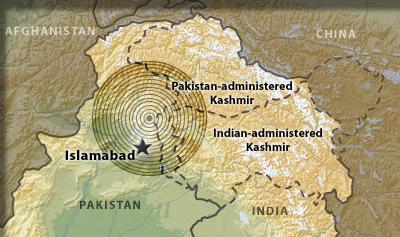
Showing the
administrative vacuum in the part of Pakistan where the famous 2005 Azad
Kashmir earthquake hit, it was not the Pakistani Armies or/and Governement but the Azad Lashkar-e- Taiba; operating under
the name Jamaat-al-Dawa, that spearheaded the rescue and relief effort--
removing the debris from collapsed buildings and providing first aid to the
injured within two hours of the earthquake:
For updates click hompage here