Al Qaeda in the Islamic
Maghreb: The Intervention Force in Mali
The U.N. Security Council unanimously passed a resolution Oct. 12 that gives the Malian
government, the African Union and West African officials 45 days to adopt a
consensus strategy for reasserting central control in northern Mali.
The status quo in Mali's north is unsustainable, both for the Malian
government and the West, and it has become evident that an external actor will
be required to tilt the balance back in favor of Mali's central government.
More will be known about the makeup of the intervention after the Oct. 19
meeting, but some preliminary conclusions can be drawn.
Mali's coup in March allowed Malian Islamist militants and Tuareg
secessionist groups to take control of the Azawad region in Mali's north.
Eventually, al Qaeda in the Islamic Maghreb turned on the Tuaregs and assumed
control over the region for itself.
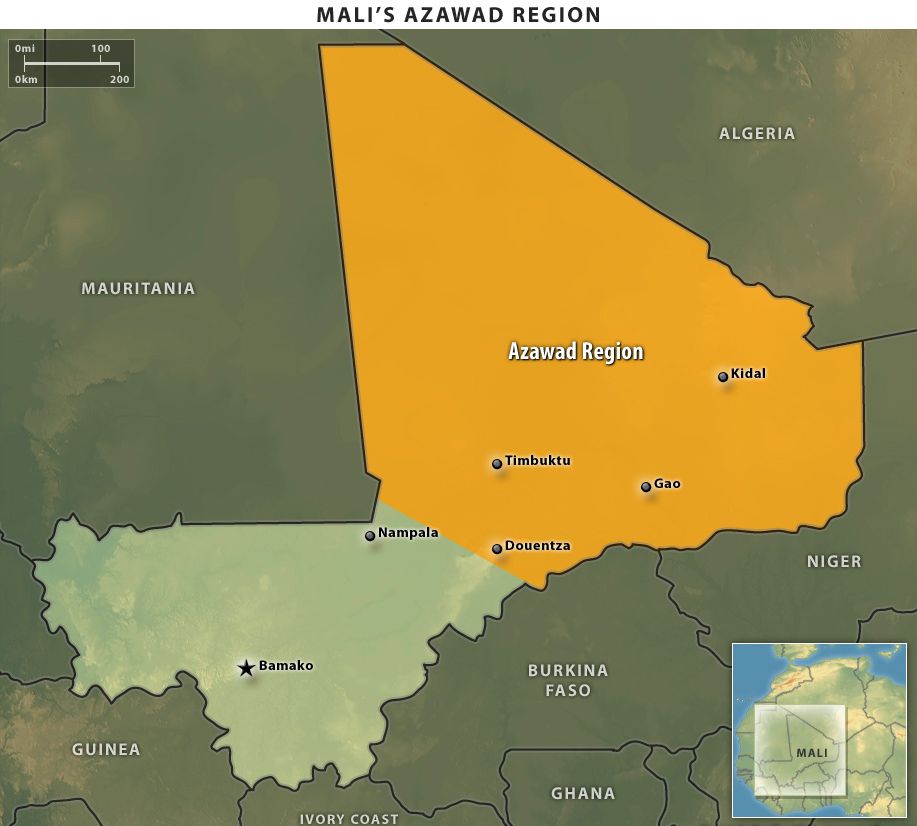
Re-establishing central political and military control in northern Mali
is probably beyond the capabilities of the national unity government in Bamako.
Already having been defeated once, troops are likely loath to return to the
north, where they would face an entrenched jihadist and militant force with
weapons stolen from the Malian armories or bought and smuggled from Libyan
depots or other regional stockpiles.
However, northern Mali at the moment is an
ungoverned space in which al Qaeda in the Islamic Maghreb or other hostile,
armed groups can operate. The Tuaregs are primarily interested in capturing
more Malian territory, while al Qaeda in the Islamic Maghreb wants space to
survive and train. The group has targeted governments in the Sahel and Maghreb
regions in the past, and there is an ongoing investigation into al Qaeda in the
Islamic Maghreb's involvement in the attack that killed the U.S. ambassador to
Libya.
It is therefore deemed necessary for foreign troops to step in. The
Economic Community of West African States has proposed a 3,300-strong
peacekeeping force to help restore central control in northern Mali. The
regional bloc in turn has appealed to the international community and the U.N.
Security Council to underwrite its mission.
Before an intervention can begin, the Malian junta that conducted the
March coup will seek safeguards in the agreement that, for legal and political
reason, requires a return to a civilian-led government. There will also be
efforts to gain the cooperation of secular Tuareg armed groups. In exchange for
a role in central government decision-making, these Tuaregs will be asked to
provide intelligence on jihadist movements in the north.
Composition of the
Intervention Force
Although France is expected to take the lead, like the African Union
Mission to Somalia, the intervention in Mali will probably be a joint
undertaking between Western backers in the international community, forces from
the host country and allied African forces. The intervention force will likely
be led by West Africans in order to underline that the
mission is an African solution to an African problem. France, the United States
and the European Union (the latter two have stated that they support France's efforts
in Mali) will provide financial and logistical assistance as well as
intelligence and coordination. Western logistical assistance will be geared
toward getting African troops into the country and, more critically,
facilitating their movement on the battlefield through the consistent provision
of vehicles, fuel and ammunition. Sustained logistical support will help to
ensure the Malian and West African military forces are equipped to advance,
seize and hold designated territory over long distances for an undetermined period of time.
While some Western-operated missions such as unmanned aerial vehicle
strikes and special operations forces raids will be planned, the number of
troops from France, the United States and other European countries will be
small. These soldiers will collect and share intelligence on militants'
locations, movements and defenses and serve as liaisons through the Sahel and
Maghreb regions. Their presence will not be obvious except through the
provision of accurate intelligence acquired from human sources, electronic
communications, aviation and satellite platforms. This intelligence will be
provided to African troops for the execution of seize-and-hold and high-value
target strike missions.
Foreign military advisers may begin arriving in Bamako and in the region
over the next few weeks to develop a picture of the battlefield before West
African troops are mobilized. The Oct. 19 meeting may reveal from which
countries these troops will be drawn. Guinea and Senegal have offered troops,
and Burkina Faso and the Ivory Coast have close relations with France and the
United States that could lead to their participation. Nigeria, the region's
dominant power, led two previous West African missions to Liberia and Sierra
Leone in the late 1990s and early 2000s. Mauritania, Niger and Algeria will
probably not contribute forces directly but instead will deploy their
militaries along their borders with Mali to try to prevent jihadists and
militants from escaping and regrouping elsewhere in the region.
It is clear that to change the balance of forces
an intervention is necessary in Mali, but it will take time. Mobilizing these
forces and transporting them to the Malian theater will probably take a couple
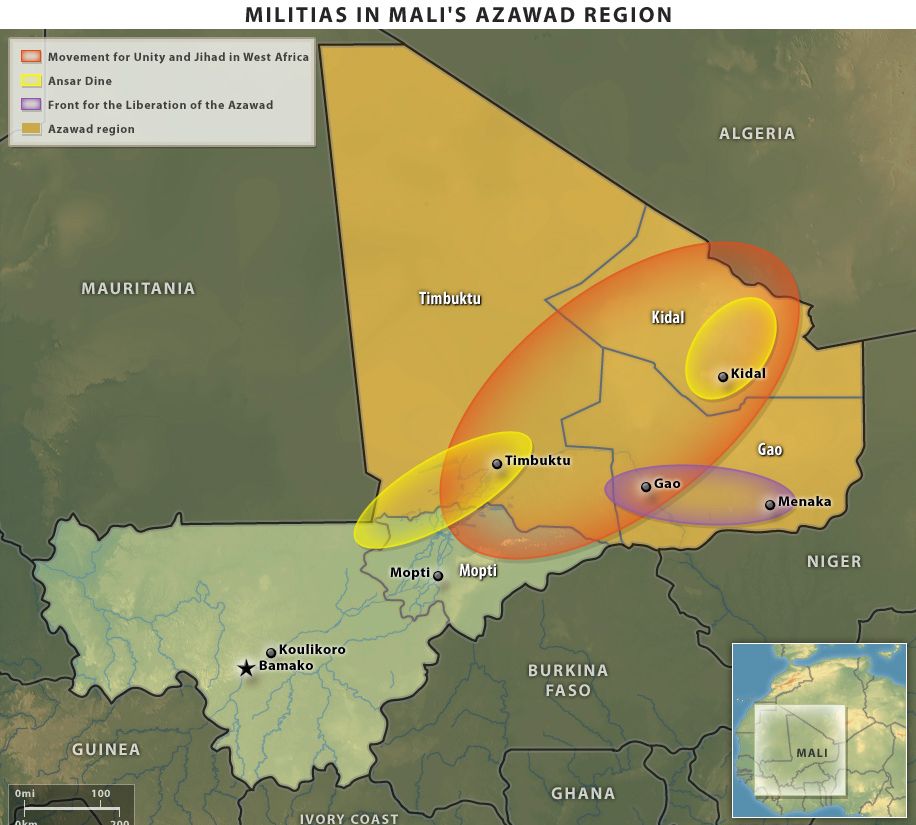
of months. West African troops will be deployed in al Qaeda in the Islamic
Maghreb's hubs in Timbuktu, Gao and Kidal only once the battlefield estimate
and logistics train are established. Add in Mali's traditional rainy season,
which lasts until roughly November or December, and it is likely that the next
several weeks or months will be set aside for planning and
intelligence-collecting purposes.
France had initially wanted to put a 30-day deadline in the council
resolution on a suitable military intervention plan.
Six French hostages are currently being held in the region by the North
African arm of al Qaeda, which has threatened to kill them in the event of
military intervention in Mali.
But as we mentioned before, illustrated
at the sequence of events in Rwanda, France does not have a good
reputation in Africa.
For updates
click homepage here